


Key Takeaways:
- Coaching and therapy share many similarities: client-focused, nondirectional, supportive, and relationship-centered
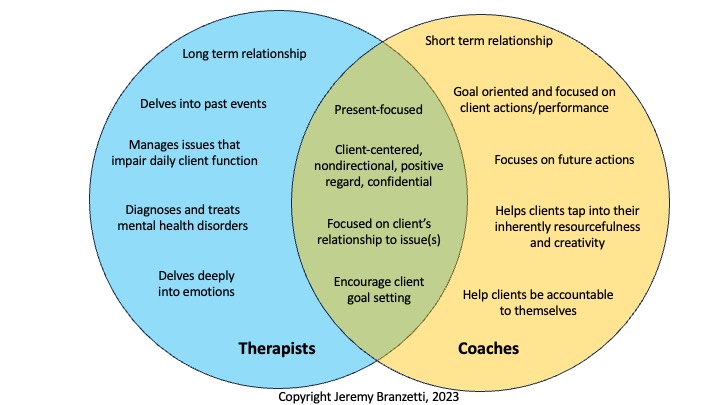
- Therapists diagnose and treat mental health conditions, and often focus on past events or trauma to explain your current function
- Coaches are thinking partners who, through incisive questions, help you set goals and identify actions to achieve them. They focus on the present, and what actions you can do going forward to make progress in your life
I’ve often colloquially referred to professional coaching as “career therapy,” and I still think that moniker holds up in many ways (though coaching certainly isn’t applicable to one’s career). Instead of the issue- or content-focused dynamic of advising or mentoring, coaching is meant to focus on a client’s relationship to the issue or content. This relationship – the feelings, motivations, beliefs, assumptions, etc. – is what a coach focuses upon to help a client build new insights that, in turn, empower them to overcome myriad challenges. To anyone who’s engaged with therapy in some way, this should sound familiar.
Therapy, like coaching, comes in many flavors, but it also focuses on the client’s relationship(s): to themselves, to others, to the issues affecting them in life, etc.. Both skirt addressing the details of the issue itself (e.g. neither aim to be problem solvers for the client) and are nondirectional (e.g., neither give solutions nor dictate client actions), and instead focus on the person (e.g., how the person sees the issue, cultivates or refines insights, and has the power to makes choices or take actions). The client is seen as an autonomous adult, and key tenets of the relationship – respect, confidentiality, positive regard – are the same. So what’s the difference?
The single biggest difference is that therapists diagnose and treat mental health conditions, something far outside the purview of any form of coaching. This often involves a focus on past events that have led the person to have this mental health issue, with the hope that doing so helps the client achieve insight into the issue and improve their current functioning. By extension, therapists require different training and certification, and these are very different from coaching training. In fact, it’s important to note that while many forms of coaching training exists, there is no actual licensing or government oversight of the coaching industry. So, as a potential customer, do your homework to see if/how a potential coach is qualified for the service they offer you.
Coaches, on the other hand, are typically present/future oriented: what’s past is past, and the main goal is to focus on what the client can do today (and beyond) to make positive progress in their lives. The underlying issue itself is, to a large extent, irrelevant; this is why coaches do not require any content expertise in the domain of the issue in which they’re coaching you. Instead, what they do is focus on your relationship to that issue and, through incisive questions, help you find ways to take action and be accountable to yourself. In fact, you might even find it preferable to have a coach who has no technical understanding of your profession, as this makes it far easier for them to simply focus on you instead of getting caught in the trap of trying to solve your issues for you.
The International Coaching Federation, the leading body offering accreditation for coaching, also offers guidelines about when coaches should refer clients to therapy. In short, if the issue seems to point to a specific mental health issue, carries heavy emotions (particularly related to past events), is leading to significant impairment in the daily function of the client, or involves concerns for the safety of the client or others, then the limits of a coach have been reached and a referral to therapy is necessary.
There are a number of other sites that address this issue out there, and I encourage you to read through their take so that you can develop a fuller understanding of coaching and therapy. But, big picture, both coaching and therapy have a lot in common. As a potential client, take some time to think through what you’re aiming to achieve, and review the simple schematic below to see which professional can best meet your needs.
Available for:
- Grand Rounds
- Faculty Development
- Scholarly Collaborations
- Professional, Scholarly, or Leadership Coaching
Contact Jeremy Branzetti
Copyright 2022, Jeremy Branzetti. All rights reserved.

 Jeremy Branzetti: Clinician. Educator. Scholar. Coach.
Leave a comment