



Key Takeaways:
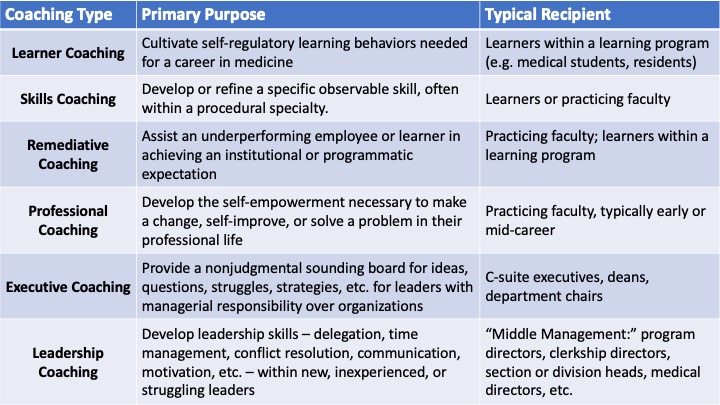
- There are numerous flavors of coaching relevant to academic medicine; your career stage and knowledge of what you aim to accomplish can help you pick the best one
- Learner coaching aims to develop skills within trainees to allow them to self-regulate (or “own”) their own learning
- Skills coaching is most similar to athletic coaching: a coach directly witnesses the coachee perform a task, provides feedback, and helps the coachee create a plan for future performance
- Remediative Coaching aims to help a struggling employee or learner meet an expected standard
- Professional Coaching is a broadly-encompassing form of coaching wherein a coachee is empowered to make a self-identified change in their professional life
- Executive Coaching is a form of coaching for high-level leaders focusing on optimizing the management of their administrative unit or organization
- Leadership coaching is similar to executive coaching, but specifically addresses leadership behaviors like communication, motivating teams, time management, etc.. This can be thought of as “middle management” coaching.
Coaching in Academic Medicine
This may come as no surprise from a blog about coaching, but the concept of coaching is becoming more and more common within the medical education world. Up to this point, it has primarily caught on at the career poles: medical students and institutional leaders. However, more and more forms of coaching have begun to appear: skills coaching within procedural specialties, professional coaching for navigating career transitions or overcome stagnation, learner coaching for developing learner skills necessary for a career in medicine, remediative coaching for addressing subpar performance, and executive and leadership coaching for institutional managers and leaders.
All of these examples demonstrate that there is indeed a Wide World of Coaching in medicine. This post aims to provide a functional description of the available forms of coaching to help readers understand the value of each. At the same time, I’m hoping to provide some standardization of vocabulary about coaching, as this term is used quite inconsistently – both in the literature and in common parlance.
Externally-Driven Coaching
Learner Coaching
Learner coaching is focused on the development of coachee within a medical education program, with a specific predilection towards junior learners. This can aim to address topics related to academic performance, clinical skills, or professionalism (Wolff et al. 2020). The central goal is the development of the learner’s ability to self-regulate their learning.
Why do these learners need help with managing their learning? A common myth about medical learners is that, in order to have gotten to into the highly competitive medical education pipeline, they must have a well-developed and highly refined approach to learning. In reality, medical learners have figured out how to thrive in a structured learning environment focused on assessment and direct instruction. Studies show they are grossly underprepared for managing their learning within an unstructured, formative, patient-centered learning environment of residency (White 2014, Nothnagle, Regan 2019, Branzetti 2022). Thus, a learner coaching curriculum is thought to be a means to help facilitate this transition and develop the requisite learning skills necessary for a longitudinal career in medicine.
Skills coaching
Skills coaching refers specifically to instances where a coach assists learners to perform observable tasks better. This form of coaching most closely aligns with traditional athletic coaching: a coach observes the activity of the learner and provides specific feedback to improve performance.
Because the most easily observed – and thus most easily assessed – skills in medicine tend to be procedural, this form of coaching first took root within the surgical specialties. During training, this takes the form of “expert coaching:” a more experienced coach helping a less-experienced learner. Faculty, on the other hand, may engage in “peer coaching,” wherein a coach suggests actions to a coachee of similar experience (Vande Walle & Greenburg). This latter form of coaching was exemplified by the seminal article by Gawande about his experience with a surgical coach (Gawande 2011).
Remediative Coaching
There is a trend of late for employers to refer employees to coaches for not meeting performance standards – typically related to professionalism (e.g. communication, patient satisfaction, interpersonal interactions, etc.). Learning programs are taking a similar approach to struggling trainees. In both instances, there is an expected performance standard that is not being met, and the coach is tasked with helping the coachee make the necessary adaptations to meet this standard.
At face value, this kind of approach is to be applauded. The bespoke attention of a 1-on-1 coaching interaction can help develop the the mutual respect, positive regard, and psychological safety needed to decrease resistance and improve motivation for change (Kalet et al. 2016). However, a worrisome conflict of interest will arise if the formative nature coaching is not truly separate from the summative assessment of an employer or learning program. If an employer is paying for a coach, then to whom is the coach ultimately responsible: the employer, or the coachee? Can the coachee engage in open and vulnerable self-reflection when they know that their employer will receive a progress report from the coach? Thus, remediative coaching shows promise, but requires clear expectations of the experience and excellent communication by all parties.
Learning, Skills, and Remediative Coaching: The Common Thread
These three forms of coaching – Learner Coaching, Skills Coaching (primarily the expert form), and Remediative Coaching – each aim to develop specific skillsets within learners that meet externally-determined performance outcomes. This will contrast significantly with the subsequent forms of coaching – professional, leadership, or executive – wherein the coachee is guided to select (and subsequently achieve) self-determined outcomes.
Coachee-Driven Coaching
Professional coaching
Professional coaching aims to help the coachee identify and develop self-identified profession-related goals and implement effective strategies to achieve them. With such a broad definition, one can see how broadly applicable professional coaching can be. In the hallmark study by Dyrbye et al. showing a significant reduction in Maslach Burnout Inventory scores, coaching topics included optimizing meaning in work, integrating personal and professional life, building social support and community at work, improving work efficiency, addressing workload, building leadership skills, pursuing hobbies and recreation, engaging in self care, and strengthening relationships outside of work (Dyrbye et al., 2019). This variety reinforces the point that it’s not the specific topic or person delivering the coaching, but rather the empowerment of the coachee to determine and achieve their self-identified needs that matters.
Thus, a simplified professional coaching definition for academics is that a coach can help you make a change, self-improve, or solve a problem.
Executive Coaching
Executive coaching has been around for quite some time within the business community, and only recently has this become more commonplace within medicine. Executive coaching is aimed specifically at administrative leaders with managerial authority over some organizational unit. The same concepts of Professional Coaching – self empowerment, mutual respectful and positive regard, goal setting and attainment – are applicable, but typically focused to the managerial responsibilities of the coachee. Such leaders are often far removed from the service line level of their organization, and this distance can lead to problematic blind spots or biases that compromise their function in this high-stakes role. Having a coach without any stake in the institution – and thus no hidden motives – can be an invaluable sounding board for their concerns, thoughts, or strategies.
Leadership Coaching
Leadership coaching is often considered a subset of executive coaching (Lewis University). Like others, I separate this out because I think there is a value to recognizing that there are many leadership roles that aren’t traditionally considered “executive.” In effect, you could consider this “middle management coaching” – people who are in charge of teams, but not large units or systems.
In academic medicine, leadership coaching is optimal for program directors, clerkship directors, section or division heads, medical directors, etc. These smaller units are often the first official position supervising or managing other people, and any struggle with the relevant skills – delegation, communication, motivation, time management, conflict resolution, negotiation, etc. – is suddenly brought to light. By engaging with a coach, a unit leader can polish these leadership skills and position themselves as excellent candidates for promotions that carry increased managerial responsibility.
Professional, Executive, and Leadership Coaching: The Common thread
In each of these forms of coaching, the coachee is drives the coaching relationship. They identify the area(s) which they want to address, develop the goals that define success, identify the actions to achieve these goals, and determine when/if they have succeeded. In all instances, the coach is in a supportive role.

For more simplified graphics describing coaching relationships, please see these two recent Academic Medicine Last Pages (sorry, I can’t post them without permission from the journal!):
- Love LM, Simonsen KA, Bowler C, Dallaghan GLB. Archetypes of Coaching Across the Medical Education Continuum. Acad Med. 2021 Dec 1;96(12):1757.
- Deiorio NM, Foster KW, Santen SA. Coaching a Learner in Medical Education. Acad Med. 2021 Dec 1;96(12):1758.
Have any thoughts about the different kinds of coaching? Anything missing?
Post Reference
- Wolff M, Hammoud M, Santen S, Deiorio N, Fix M. Coaching in undergraduate medical education: a national survey. Med Educ Online. 2020 Dec;25(1):1699765.
- White C, Bradley E, Martindale J, et al. Why are medical students ‘checking out’ of active learning in a new curriculum?. Med Educ. 2014;48(3):315-324.
- Nothnagle M, Anandarajah G, Goldman RE, & Reis S. Struggling to be self-directed: residents’ paradoxical beliefs about learning. Acad Med. 2011; 86(12):1539–1544.
- Regan L, Hopson LR, Gisondi MA, Branzetti J. Learning to learn: A qualitative study to uncover strategies used by Master Adaptive Learners in the planning of learning. Med Teach. 2019; 41(11):1252–1262
- Branzetti J, Commissaris CV, Croteau C, Ehmann M, Gisondi M, Hopson LR, Kai KY, Regan L. “The Best Laid Plans? A qualitative investigation of how resident learners plan their learning. Acad Med. 2022; in press.
- Gawande A. The coach in the operating room. The New Yorker. https://www.newyorker.com/magazine/2011/10/03/personal-best. Published September 26, 2011. Accessed April 6, 2022.
- Vande Walle K, Greenberg C. Surgical coaching. American College of Surgeons. https://www.facs.org/education/division-of-education/publications/rise/articles/surg-coaching. Accessed April 6, 2022.
- Kalet A, Guerrasio J, Chou CL. Twelve tips for developing and maintaining a remediation program in medical education. Med Teach. 2016;38(8):787-792.
- Dyrbye LN, Shanafelt TD, Gill PR, Satele DV, West CP. Effect of a Professional Coaching Intervention on the Well-being and Distress of Physicians: A Pilot Randomized Clinical Trial. JAMA Intern Med. 2019;179(10):1406-1414.
- University L. Executive Coaching vs. Leadership Coaching—Similar, but Different. Lewis University Experts Blog. https://www.lewisu.edu/experts/wordpress/index.php/executive-coaching-vs-leadership-coaching-similar-but-different/. Published April 20, 2021. Accessed April 6, 2022.
Available for:
- Grand Rounds
- Faculty Development
- Scholarly Collaborations
- Professional, Scholarly, or Leadership Coaching
Contact Jeremy Branzetti
Copyright 2022, Jeremy Branzetti. All rights reserved.
 Jeremy Branzetti: Clinician. Educator. Scholar. Coach.
Leave a comment