


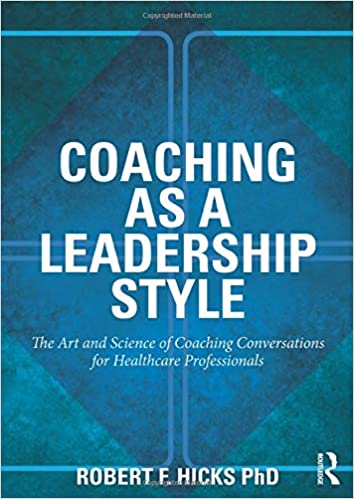

I can think of few better topics to write a post about in these early days of the AEC blog than coaching and leadership within healthcare. In Coaching as a Leadership Style, Dr. Robert Hicks provides both a model for coaching individuals within the healthcare space, but also a convincing argument that the techniques of coaching are perfectly suited to the transformational style of leadership. This approach makes this book serve double-duty as a framework for traditional 1-on-1 coaching relationships and as a guide for leaders of modern healthcare systems – both of which are grounded in psychological concepts of coaching.
In this post, I’ll briefly review the Coaching Model, the Coach as Leader before summarizing some helpful takeaways. If any of this content resonates with you, I’d strongly recommend picking up this book. To be honest, even if you aren’t pursuing coaching/being coached, I think this is a great book to help medical education leaders navigate change in their program.
The Coaching Model
The model focuses on 4 distinct phases: Support for Thought, Challenge for Thought, Challenge for Action, and Support for Action. As you can see, these phases consist of the coach deploying a strategy based on 2 conceptual axes: support vs challenge, and thought vs action.
Support for Thought is centered around rapport building. A coach has to be seen as a credible, caring, and engaged guide to the coachee. By adopting the adult ego state and deliberately building rapport, the groundwork for change is laid by the coach.
Challenge for Thought uses the positive rapport established in Support for Thought to help the coachee visualize and then specify an achievable outcome that captures the change they wish to make.
Challenge for Action helps the coachee develop the plan to achieving their goal(s) from Challenge for Thought; to use the words of Dr. Hicks, this action develops the pathway by which a coachee can achieve their desired outcome.
Support for Action helps the coachee identify the self-confidence and motivation to advance from a state of ambivalence or pre-contemplation to one of forward movement along the path identified in Challenge for Action.
It’s important to note that these steps do not have to be linear and there can often be a need to move between stages as the situation demands. In effect, this navigation of the 4 stages is at the crux of what a coach actually does.
Coach as Transformational Leader
My first dedicated inquiry into leadership styles was through my MHPE, and I found the experience to be incredibly helpful – particularly as I was squarely in the role of “middle management” as a residency director. The assignment was to assess what form of leadership exists within you unit (e.g., department), and then determine how that affects any changes (e.g. new curricula) you plan to make. This article by Lieff et al. is particularly helpful for those looking to learn more about leadership, as is this post about Transformational Leadership.
As one may deduce from the name, transformational leadership is a form of leadership that aims to induce change. There are many different leadership models, but Transformational Leadership focuses on four principles (Bass & Riggio, 2014): Idealized Influence, Inspirational Motivation, Intellectual Stimulation, and Individualized Consideration. In the interest of brevity I’ll avoid a description of each, and simply consolidate them into a single description: A Transformational Leader provides a compelling purpose and direction of a change, and then uses role modeling of ideal behaviors and inclusive practices to get everyone on board to carry out that change.
My Personal Takeaways:
- (Education Leader*) – (hierarchical superiority) = Coach
- *Applies to any of the following: Residency Director, Clerkship Director, Assistant/Associate Directors, Vice Chair of Education, etc.
- The key point? If you’re a medical educator – really, a teacher of any kind – coaching is already a huge part of your life. A resource like this book that helps break it down to underlying psychological concepts and practices is invaluable.
- Education leaders are transformational leaders by default. Why? Because education program leaders – typically lacking access to traditional levers of incentivization like financial rewards or control over faculty academic time – need to rely on “soft power” skills like relationship-building and motivation practices to convince others to give time and effort to the education mission. This practice is exactly what Transformational Leadership represents, and thus I think it would benefit education leaders (PDs, APDs, CDs, VCs of Education, etc.) to learn more about it.
Have any thoughts you’d like to share about Coaching or Leadership?
References
- Hicks R. Coaching as a Leadership Style: The Art and Science of Coaching Conversations for Healthcare Professionals. New York: Routledge, Taylor & Francis Group; 2014.
- Bass BM, Riggio RE. Transformational Leadership. New York.: Routledge; 2014.
Available for:
- Grand Rounds
- Faculty Development
- Scholarly Collaborations
- Professional, Scholarly, or Leadership Coaching
Contact Jeremy Branzetti
Copyright 2022, Jeremy Branzetti. All rights reserved.
 Jeremy Branzetti: Clinician. Educator. Scholar. Coach.
Leave a comment